Use zones and process lines when a psychrometric chart needs to communicate constraints or movement between states, not just point observations. For model-based thermal comfort layers that calculate PMV, SET, or adaptive comfort across the chart, see Comfort overlays.
Comfort and operating zones
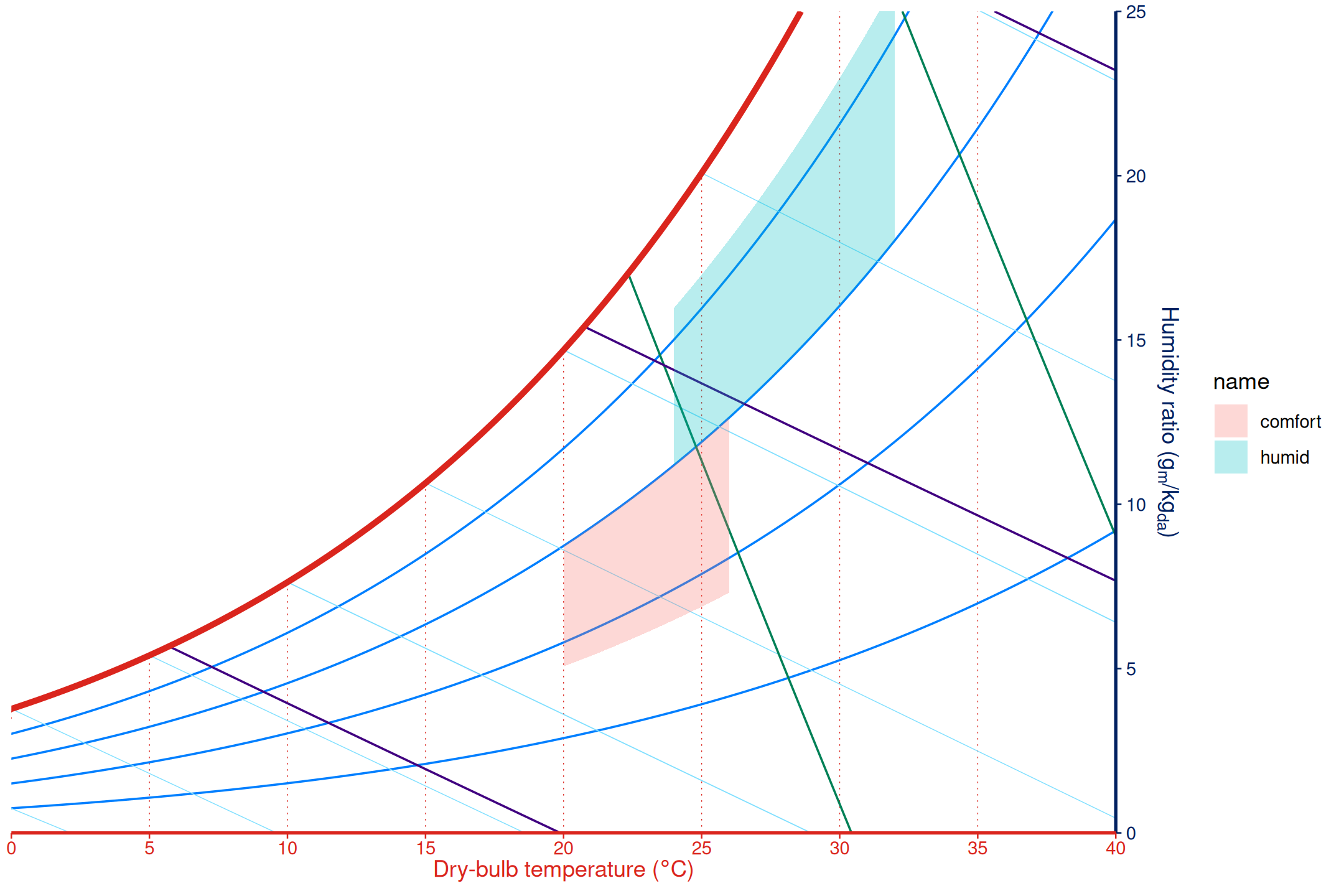
geom_psychro_zone() draws filled psychrometric regions.
The default zone type, "dbt-rh", uses dry-bulb and
relative-humidity limits.
zones <- rbind(
    data.frame(
        name = "comfort",
        tdb_min = 20, tdb_max = 26,
        relhum_min = 35, relhum_max = 60
    ),
    data.frame(
        name = "humid",
        tdb_min = 24, tdb_max = 32,
        relhum_min = 60, relhum_max = 85
    )
)

ggpsychro(tdb_lim = c(0, 40), hum_lim = c(0, 25)) +
    psychro_preset("minimal") +
    geom_psychro_zone(
        aes(
            tdb_min = tdb_min, tdb_max = tdb_max,
            relhum_min = relhum_min, relhum_max = relhum_max,
            fill = name
        ),
        data = zones,
        type = "dbt-rh",
        alpha = 0.28,
        colour = NA
    )
Process lines and state points
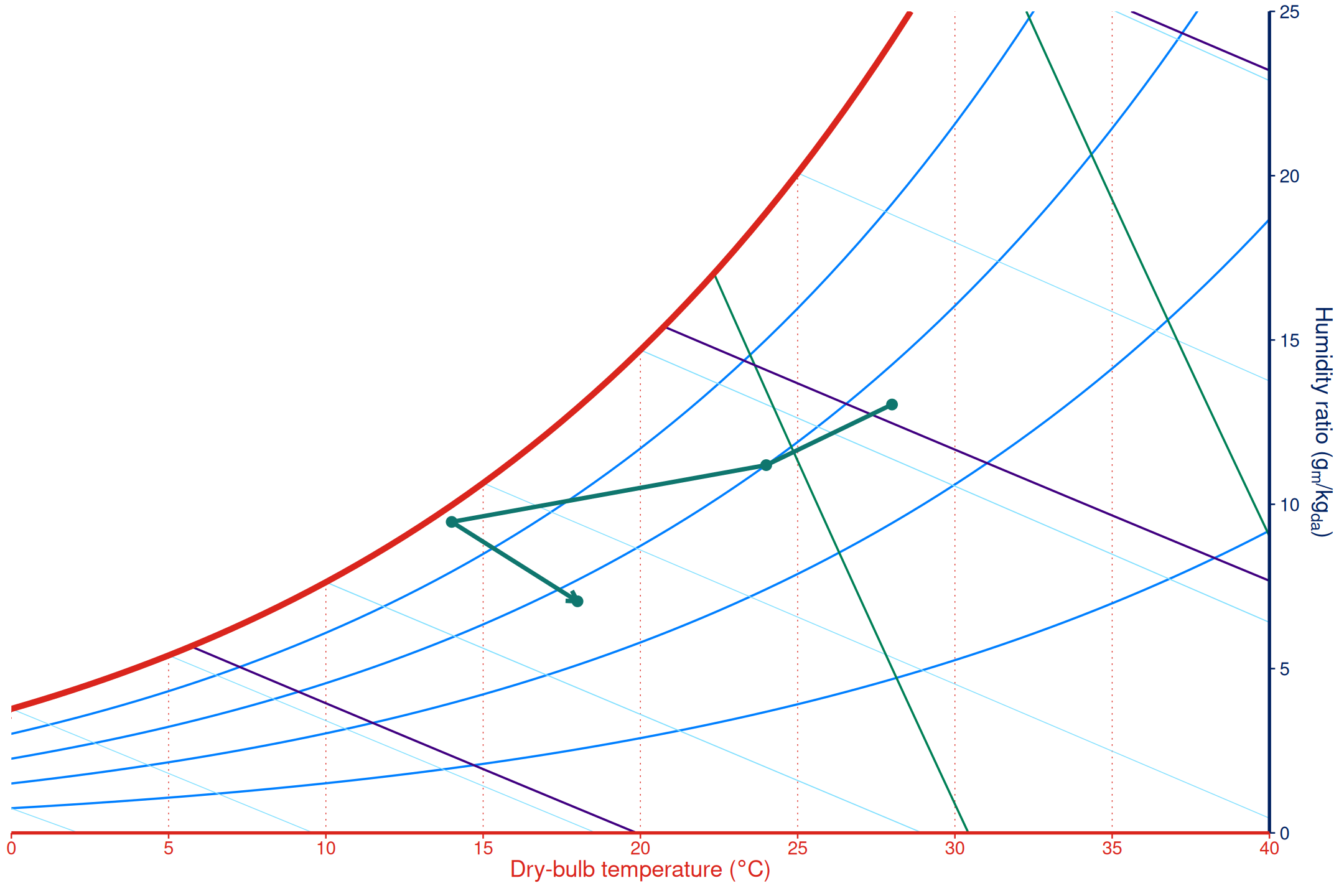
geom_psychro_process() draws a path through state
points. Supply tdb plus exactly one state property:
humratio, relhum, wetbulb,
vappres, specvol, or enthalpy.
Relative humidity is supplied as percent values.
process <- data.frame(
    stage = c("return", "mixed", "cooled", "supply"),
    dry_bulb_temperature = c(28, 24, 14, 18),
    relative_humidity = c(55, 60, 95, 55)
)

ggpsychro(tdb_lim = c(0, 40), hum_lim = c(0, 25)) +
    psychro_preset("minimal") +
    geom_psychro_process(
        aes(tdb = dry_bulb_temperature, relhum = relative_humidity),
        data = process,
        colour = "#0f766e",
        linewidth = 1,
        arrow = grid::arrow(length = grid::unit(0.08, "inches"))
    ) +
    stat_psychro_state(
        aes(tdb = dry_bulb_temperature, relhum = relative_humidity),
        data = process,
        colour = "#0f766e",
        size = 2
    )
Other zone types
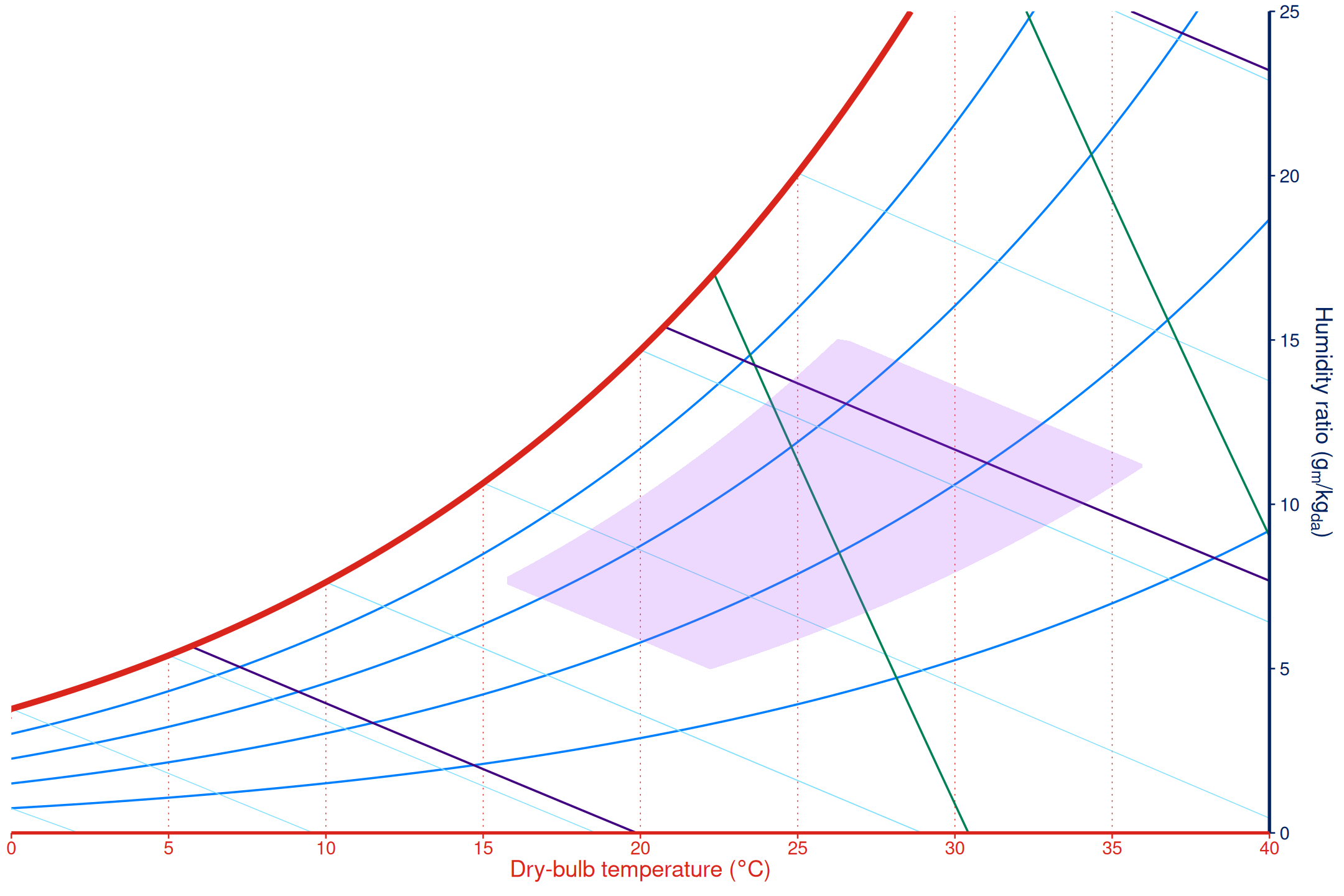
Zones can also be bounded by enthalpy and relative humidity, specific volume and relative humidity, dry-bulb plus a maximum humidity ratio, or explicit polygon points.
limits <- data.frame(
    enthalpy_min = 35000,
    enthalpy_max = 65000,
    relhum_min = 30,
    relhum_max = 70
)

ggpsychro(tdb_lim = c(0, 40), hum_lim = c(0, 25)) +
    psychro_preset("minimal") +
    geom_psychro_zone(
        aes(
            enthalpy_min = enthalpy_min, enthalpy_max = enthalpy_max,
            relhum_min = relhum_min, relhum_max = relhum_max
        ),
        data = limits,
        type = "enthalpy-rh",
        fill = "#a855f7",
        alpha = 0.22,
        colour = NA
    )
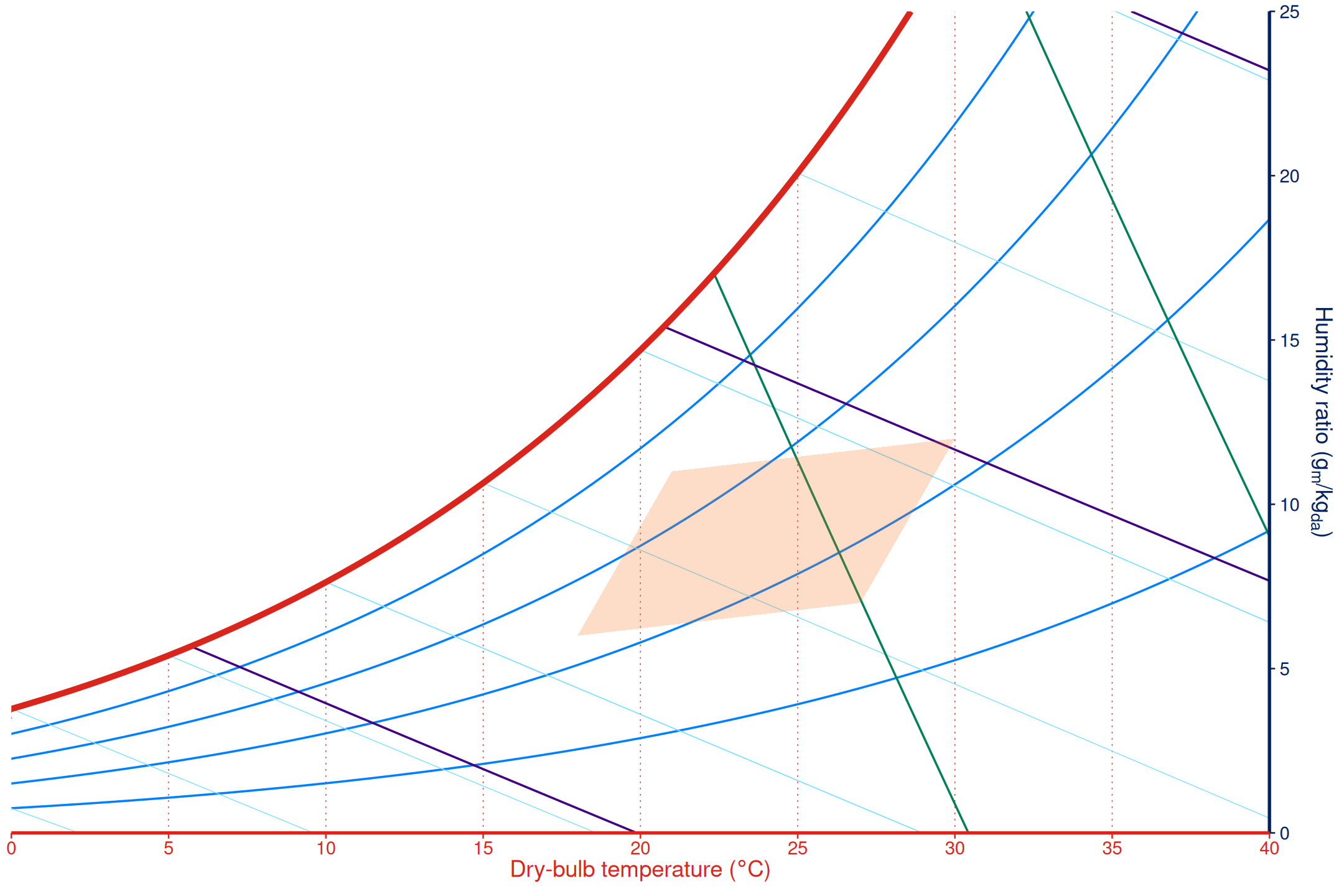
Use type = "xy-points" when the desired region is
already known as polygon points in dry-bulb temperature and display
humidity-ratio units.
polygon_zone <- data.frame(
    tdb = c(18, 27, 30, 21),
    humratio = c(6, 7, 12, 11)
)

ggpsychro(tdb_lim = c(0, 40), hum_lim = c(0, 25)) +
    psychro_preset("minimal") +
    geom_psychro_zone(
        aes(tdb = tdb, humratio = humratio),
        data = polygon_zone,
        type = "xy-points",
        fill = "#f97316",
        alpha = 0.24,
        colour = NA
    )